Confusion Matrix
Imagine you teach a computer to tell the difference between dogs and cats. To know if the computer is learning well, you check its answers against the real answers.
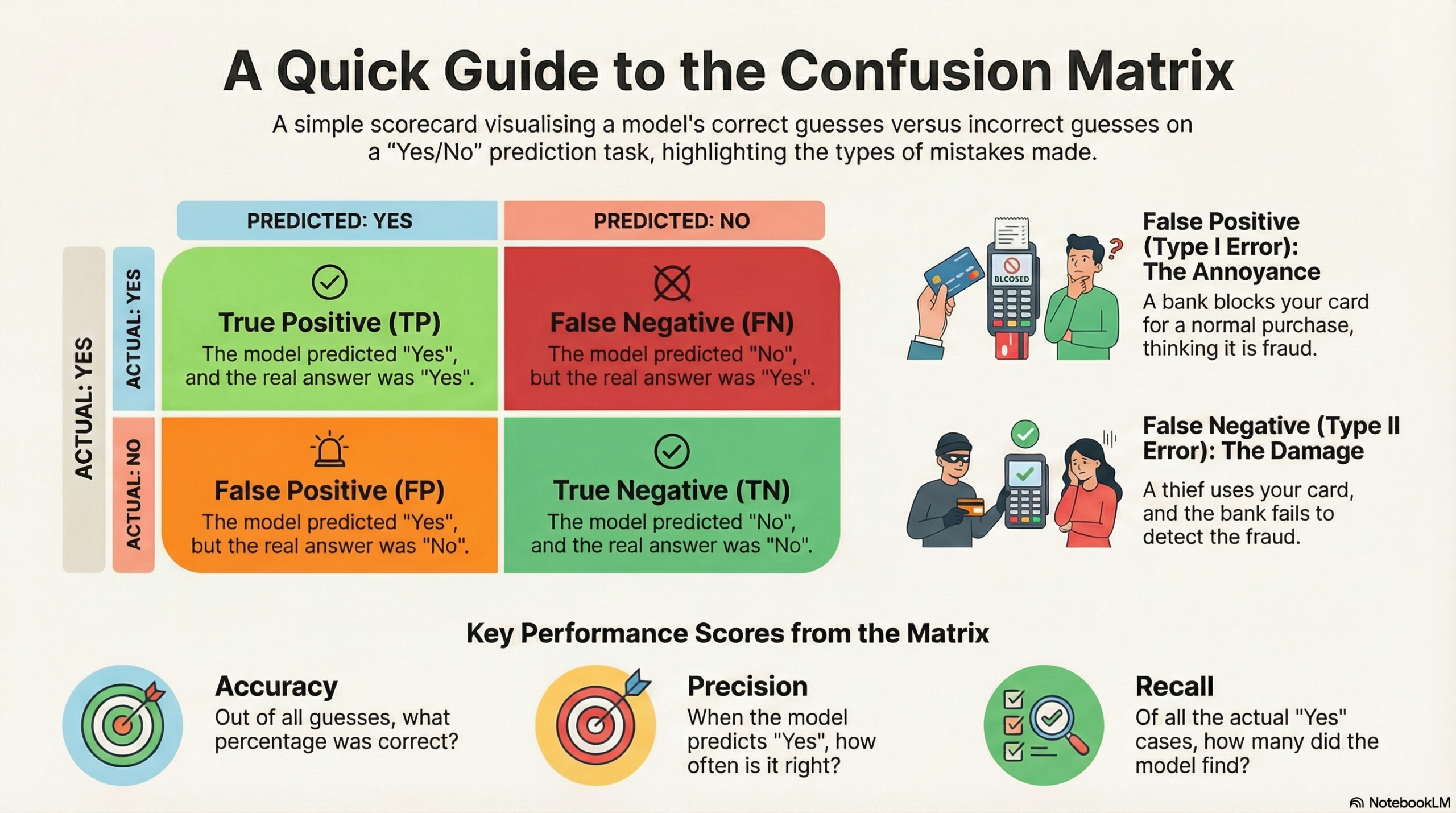
A Confusion Matrix is just a table (a scorecard) that shows us:
- When the computer was Right.
- When the computer was Wrong.
- How it was wrong (what kind of mistake it made).
We usually use this for “Yes/No” problems (like: Is it Fraud? Is it Spam? Is it Sick?).
Confusion Matrix
🟢 The 4 Key Outcomes
There are only 4 possible things that can happen when the computer makes a guess. We use the terms Positive (Yes, it is fraud) and Negative (No, it is safe).
| Term | What it means (Simple English) | Example in Fraud Detection |
|---|---|---|
| TP (True Positive) | The computer guessed Yes, and the real answer was Yes. | Computer said “Fraud” and it really was fraud. ✅ |
| TN (True Negative) | The computer guessed No, and the real answer was No. | Computer said “Safe” and it really was safe. ✅ |
| FP (False Positive) | The computer guessed Yes, but the real answer was No. | Computer said “Fraud” but it was actually a safe buy. ❌ |
| FN (False Negative) | The computer guessed No, but the real answer was Yes. | Computer said “Safe” but it was actually fraud. ❌ |
📊 The Matrix Table
Here is how we arrange those numbers into a grid.
- Rows = The Real Truth (Actual).
- Columns = The Computer’s Guess (Predicted).
| Computer Guesses: YES | Computer Guesses: NO | |
|---|---|---|
| Real Truth is: YES | TP (Correct) | FN (Missed it) |
| Real Truth is: NO | FP (False Alarm) | TN (Correct) |
🔍 Types of Errors
In simple statistics, we give names to the mistakes:
1. FP = Type I Error (False Alarm)
- Meaning: The alarm rings when there is no fire.
- Example: You try to buy a pizza, but the bank blocks your card thinking it is fraud.
- Result: Annoying, but you can usually fix it by calling the bank.
2. FN = Type II Error (The Dangerous Miss)
- Meaning: The alarm stays silent when there is a fire.
- Example: A thief steals your credit card info and buys a laptop, but the bank thinks it is you.
- Result: You lose money. This is usually more dangerous than a False Alarm.
💡 Real-Life Example: The Email Spam Filter
Let’s say you have an email filter that tries to block spam emails.
- Positive (+) = Spam Email.
- Negative (-) = Good Email (from friends/boss).
| Outcome | Meaning | Is it bad? |
|---|---|---|
| TP | Filter puts a spam email in the junk folder. | ✅ Good! |
| TN | Filter lets a good email go to your inbox. | ✅ Good! |
| FP | Filter puts a good email from your boss in the junk folder. | ❌ Bad! You might miss an important meeting. |
| FN | Filter lets a spam email into your inbox. | ❌ Bad! You get annoying scam messages. |
📈 Important Metrics (The Score)
The matrix gives us the numbers, but we often use those numbers to calculate grades for the computer.
- Accuracy: Out of all guesses, how many were right?
- Formula: (TP+TN)/Total 2. Precision: When the computer says “Yes”, how often is it actually right? (How many alarms were real fires?)
- Formula: TP/(TP+FP) 3. Recall (Sensitivity): Out of all the real “Yes” events, how many did the computer catch? (Did it catch all the fraud?)
- Formula: TP/(TP+FN)
💻 Understanding the Python Code
You provided code in your prompt. Here is a simple explanation of what that code is doing, step-by-step:
make_classification: This creates fake data for us to practice with. It creates 1000 rows of data with 2 categories (Class 0 and Class 1).train_test_split: We cut the data into two piles.- Train pile: To teach the computer.
- Test pile: To test the computer later (like a final exam).
LogisticRegression: This is the “Brain” (Model) we are teaching.model.fit: The computer studies the Train pile.model.predict: The computer guesses the answers for the Test pile.confusion_matrix: This compares the computer’s guesses (y_pred) against the real answers (y_test) and gives us the table of TP, TN, FP, FN.ConfusionMatrixDisplay: This draws the colorful picture so you can see the results easily.
Confusion Matrix
💻 Python Code (Fraud Detection with Confusion Matrix)
This code trains a Logistic Regression model and prints the raw confusion matrix numbers before showing the visual chart.
from sklearn.datasets import make_classification
from sklearn.model_selection import train_test_split
from sklearn.linear_model import LogisticRegression
from sklearn.metrics import confusion_matrix, ConfusionMatrixDisplay
import matplotlib.pyplot as plt

# 1. Generate sample data (1000 fake transactions)
X, y = make_classification(n_samples=1000, n_features=5, n_classes=2, random_state=42)

# 2. Split data: 80% training, 20% testing
X_train, X_test, y_train, y_test = train_test_split(
    X, y, test_size=0.2, random_state=42
)

# 3. Train Logistic Regression model
model = LogisticRegression()
model.fit(X_train, y_train)

# 4. Predict test data
y_pred = model.predict(X_test)

# 5. Create confusion matrix
cm = confusion_matrix(y_test, y_pred)

# Print raw values
print("Confusion Matrix (Raw Numbers):")
print(cm)
print("\nMapping of the matrix:")
print("[[TN, FP],")
print(" [FN, TP]]")

# 6. Plot confusion matrix
disp = ConfusionMatrixDisplay(
    confusion_matrix=cm,
    display_labels=['Not Fraud (0)', 'Fraud (1)']
)

disp.plot(cmap='Blues')
plt.title('Confusion Matrix: Fraud Detection')
plt.show()
🖥️ Output of the Code
1️⃣ Console Output (Raw Numbers)
Confusion Matrix (Raw Numbers):
[[96  4]
 [ 6 94]]

Mapping of the matrix:
[[TN, FP],
 [FN, TP]]
2️⃣ Visual Output (Confusion Matrix Chart)
| Actual \ Predicted | Not Fraud | Fraud |
|---|---|---|
| Not Fraud | 96 (Dark Blue) | 4 (Light Blue) |
| Fraud | 6 (Light Blue) | 94 (Dark Blue) |
📌 Darker blue = higher value
🧐 How to Read the Confusion Matrix
🔹 Row 1: Actual = Not Fraud (0)
- 96 → TN (True Negative)
Correctly identified safe transactions ✅ - 4 → FP (False Positive)
Safe transactions wrongly flagged as fraud ❌
👉 Type I Error
🔹 Row 2: Actual = Fraud (1)
- 6 → FN (False Negative)
Fraud transactions missed by the system ❌
👉 Type II Error (Most Dangerous) - 94 → TP (True Positive)
Fraud correctly detected ✅
🚨 Error Summary
| Error Type | Value | Meaning |
|---|---|---|
| Type I Error (FP) | 4 | False alarm |
| Type II Error (FN) | 6 | Missed fraud |
🎯 Final Takeaway (Exam-Ready)
In fraud detection, False Negatives (Type II errors) are more dangerous than False Positives (Type I errors).
Therefore, models are often tuned to catch more fraud, even if it causes a few false alarms.
Confusion Matrix
About the Author